
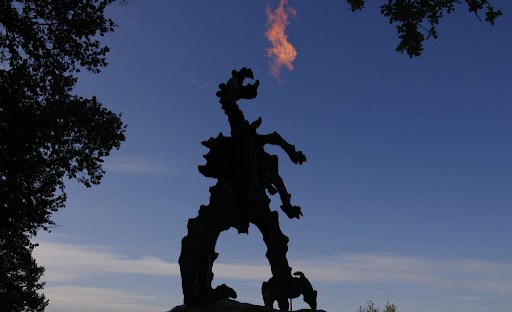
When you think of Poland, your mind might first go to its hearty cuisine, rich history, or stunning landscapes. But beneath the surface of modern cities and tranquil countryside lies a world pulsating with ancient magic, a realm where mythical creatures are woven into the very fabric of the nation’s identity. These aren’t just fairy tales; they are foundational legends that explain the origins of cities, teach moral lessons, and reflect the Slavic soul. So, let’s embark on a journey from the depths of a dragon’s den to the banks of a river guarded by a mermaid.
The Wawel Dragon: Kraków’s Fiery Guardian
No creature is more iconic in Polish lore than the Smok Wawelski, the Dragon of Wawel Hill. His story is the cornerstone of Kraków’s origin myth. As the legend goes, a fearsome dragon took up residence in a cave at the foot of Wawel Castle, terrorizing the kingdom of King Krakus. It devoured livestock and demanded regular sacrifices of young maidens, leaving the city in a state of perpetual fear.
The king promised his daughter’s hand and half the kingdom to anyone who could defeat the beast. Knights from far and wide tried and failed. The hero who finally succeeded was not a mighty warrior in shining armor, but a clever cobbler’s apprentice named Skuba. Instead of confronting the dragon directly, he devised a cunning plan. He stuffed a lamb’s skin with sulphur and left it as a tempting meal for the creature. The dragon devoured it, and soon, an unquenchable fire grew in its belly. In agony, it rushed to the Vistula River and drank so much water that it eventually burst!
Skuba married the princess, and the city of Kraków was founded, living in peace. The dragon’s cave remains a major tourist attraction today, with a magnificent bronze statue breathing real fire every few minutes—a playful nod to the legend that continues to captivate visitors.
The Warsaw Mermaid: A Symbol of Resistance
While Copenhagen has its Little Mermaid, Warsaw has its own, far more formidable siren—Syrenka Warszawska. But don’t expect a passive figure pining for a prince. The Polish mermaid is a warrior.
The legend tells that a mermaid swam from the Baltic Sea up the Vistula River and stopped near the future site of Warsaw, enchanted by the sandy banks and lush forests. Local fishermen soon noticed that something was disturbing the river currents and tangling their nets. When they captured the creature, they were stunned by her beautiful singing. A rich merchant, seeing an opportunity, imprisoned her to make a profit.
Hearing her cries, a young fisherman’s son helped her escape. Grateful for her freedom, the mermaid vowed to protect the people who saved her. She emerged from the water with a sword and a shield, ready to defend their settlement. This is why the official coat of arms of Warsaw depicts a mermaid with a raised sword and shield—a symbol of the city’s fierce independence and resilience, qualities that have been tested time and again throughout history.
Beyond the Famous Duo: The Mischievous and the Mysterious
The mythical bestiary of Poland doesn’t end there. The forests and lakes are home to a host of other fascinating beings:
- Latawiec: A mischievous, often malevolent spirit of the air, akin to a demonic kite or a small dragon. It was believed to cause storms and whirlwinds, and could sometimes be summoned by a sorcerer to steal milk or grain.
- Południca (The Lady Noon): A personification of the dangerous midday heat. She was depicted as a tall, pale woman dressed in white, who would appear in fields during harvest time to challenge workers with riddles or… much worse. She served as a cautionary tale about the importance of taking a rest during the hottest part of the day.
- Bazyliszek (The Basilisk): A terrifying creature with the head of a rooster, the eyes of a toad, and a serpent’s body. Its gaze was so powerful it could turn a person to stone. A famous Warsaw legend tells of a basilisk living in the cellars of a street, defeated only by a man using a mirror to reflect its own deadly gaze.
These legends are more than just stories. They are a vibrant part of Poland’s cultural heritage, connecting the past to the present. The next time you walk through the Main Square in Kraków or see the mermaid emblem in Warsaw, remember—you’re not just in a city; you’re standing in a place where myths are real, and magic is just around the corner.
Discover more from Valodu kursi 🌍 Tulkošanas pakalpojumi
Subscribe to get the latest posts sent to your email.


