
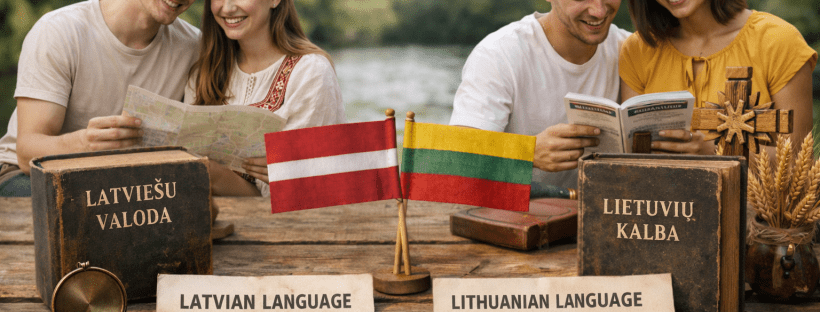
If languages were families, the Baltic branch would be a small but fascinating heirloom cabinet. Within it, Latvian and Lithuanian stand as the last two surviving members of a once-larger group. To many outsiders, they seem like twins. For locals, the differences are as clear as day. Let’s explore these two unique linguistic treasures, uncovering both what binds them together and what sets them passionately apart.
A Shared Ancient Legacy
First, the bond. Latvian and Lithuanian are not Slavic, though they’re often geographically grouped with them. They form their own Baltic branch within the Indo-European family. Their shared ancestry is profound.
Ancient Echoes: Both languages are incredibly conservative, meaning they’ve preserved features lost in most other European tongues. Linguists often hail Lithuanian as the most archaic living Indo-European language. Its system of noun cases and verb conjugations is a goldmine for understanding ancient Proto-Indo-European. Latvian, while having undergone more changes, still holds onto this ancient core.
Grammar Blueprint: The structural foundation is similar. Both have a complex system of noun cases (seven in Lithuanian, six in modern Latvian). Verbs have similar tenses and moods. The free word order, determined by cases rather than sentence position, is a key shared trait.
The Sound of Divergence
This is where the first major differences greet your ear. The phonological character of each language is distinct.
- Lithuanian has a melodic, almost song-like quality to many ears. It uses a pitch accent system, where the tone (rising or falling) on a syllable can change the meaning of a word. It also features a larger set of diphthongs and a more consistent relationship between spelling and pronunciation.
- Latvian has a very characteristic steady, staccato rhythm, with a fixed stress almost always on the first syllable. This gives it a distinctive “dancing” cadence. It has also developed unique sounds, like the velarized “l” and “ņ,” “ķ,” “ļ,” “š,” “ž,” which aren’t found in Lithuanian.
Lexicon: Cousins, Not Clones
This is where the “false friends” live. While the core vocabulary shares deep roots, centuries of separate influences have shaped their lexicons.
- Lithuanian retained more of its pure Baltic roots. Its vocabulary often looks and sounds more ancient.
- Latvian has been significantly influenced by its northern neighbors. It contains a substantial layer of Livonian (a Finnic language) substrate words and, most notably, a large number of German loanwords, a legacy of 700 years of Teutonic and Hanseatic influence. Russian loanwords appear in both, but to differing degrees based on historical periods.
Let’s see a few examples:
- City: Pilsēta (Latvian) vs. Miestas (Lithuanian). The Latvian word is borrowed from German (Burgstädt), while the Lithuanian is Baltic.
- Window: Logs (Latvian, from German Loch) vs. Langas (Lithuanian).
- Bread: Maize (Latvian, a Finnic substrate word) vs. Duona (Lithuanian). A classic example of a fundamental word being completely different!
Grammar: The Devil in the Details
The shared complex grammar has key divergences:
- Noun Cases: Lithuanian retains a more robust and frequently used system of seven cases. Latvian has simplified to six, with the instrumental case being much rarer.
- Verb Reflexivity: Lithuanian often uses reflexive verbs where Latvian would use a non-reflexive form.
- Future Tense: Lithuanian has a distinct synthetic future tense (dirbsiu – “I will work”). Latvian forms its future analytically, using an auxiliary verb (es strādāšu, literally “I will work,” but structured as “I will be working”).
Mutual Intelligibility: The Great Myth
Here’s the bottom line: They are not mutually intelligible. A Latvian and a Lithuanian cannot have a conversation each using their own language. They can, however, achieve “passive” or “receptive” intelligibility with effort and exposure—spotting common roots, guessing from context, and recognizing grammatical structures. It’s akin to a Spaniard listening to Italian: they’ll grasp the topic, but miss the details.
Cultural & Modern Identity
Today, both languages are pillars of vibrant national identities.
- Lithuanian is spoken by about 3 million people and is fiercely protected as a symbol of ancient heritage.
- Latvian is spoken by about 1.5 million people and has undergone a remarkable revitalization since regaining independence, actively purging some Soviet-era Russian influences and standardizing its form.
So, Which is “Harder” to Learn?
For an English speaker, both are challenging due to their case systems and unfamiliar vocabulary. Lithuanian is often cited as more difficult due to its more intricate grammar and pitch accent. Latvian’s fixed first-syllable stress is easier to master, but its vocabulary can be less transparent due to the mix of influences.
Final Thoughts
Comparing Latvian and Lithuanian is not about finding a winner; it’s about appreciating two remarkable survivors. Lithuanian is like a living museum, a direct window to our linguistic past. Latvian is a resilient fusion, a testament to adaptation while maintaining its Baltic soul.
Listening to them is like hearing two variations on an ancient song—one holding the original melody with fierce precision, the other adding unique and compelling harmonies born of its own history. To understand one is to gain a deep appreciation for the other, and for the incredible diversity of human language itself.
Discover more from Valodu kursi 🌍 Tulkošanas pakalpojumi
Subscribe to get the latest posts sent to your email.

 Valodu kursi 🌍 Tulkošanas pakalpojumi
1 doma par “Baltic Siblings: A Journey Through Latvian and Lithuanian”