
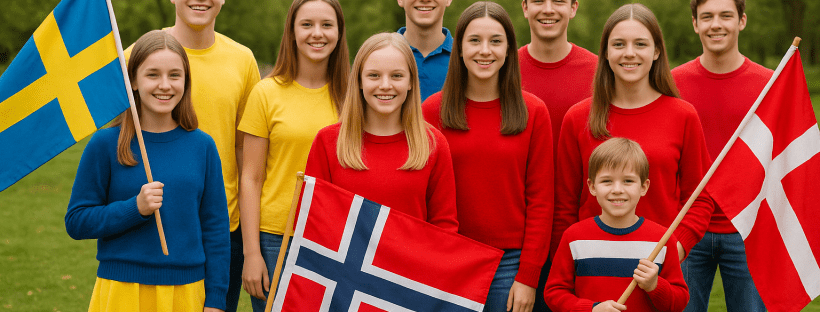
If you’ve ever looked at a map of Scandinavia and wondered about the languages spoken there, you’re not alone. The relationship between Danish, Norwegian, and Swedish is a fascinating tale of shared history, dramatic splits, and remarkable reunion. Are they nearly identical, or wildly different? The answer is a delightful mix of both.
Let’s unravel the family tree and discover if these languages are close siblings or slightly more distant cousins.
The Common Ancestor: Old Norse
First, we need to go back in time to the Viking Age. For centuries, a common language known as Old Norse was spoken across the region. Picture Vikings from what is now Norway, Denmark, and Sweden understanding each other relatively easily as they traded, raided, and explored.
As time passed and kingdoms solidified, regional dialects began to drift apart. This divergence accelerated with the Black Death, changing trade routes, and, crucially, the different political and religious influences from Germany that shaped Denmark and Sweden. This is the point where the single language began to branch into the three we know today.
The Sibling Rivalry: Danish, Norwegian, and Swedish
Today, Danish, Norwegian, and Swedish are considered mutually intelligible to a large degree. This means that with a bit of effort, speakers of one can understand the other two. Think of them as three siblings who grew up in the same house but developed their own distinct personalities.
Here’s a quick look at their unique traits:
- Swedish: Often described as melodic and sing-song, thanks by its distinctive pitch accent. For many learners, its pronunciation is the most intuitive of the three. Key vocabulary can sometimes differ from its siblings (e.g., the word for “to think” is tänka in Swedish but tenke in Norwegian).
- Norwegian: Linguists often call Norwegian the “middle child” and the perfect bridge between its siblings. Its two written forms, Bokmål (heavily influenced by Danish) and Nynorsk (based on rural Norwegian dialects), reflect its unique history. After centuries under Danish rule, Norway developed a spoken language that sounded similar to Swedish but was often written like Danish. Its pronunciation is generally considered clearer than Danish.
- Danish: The rebel of the family when it comes to sound. While its written form looks very similar to Norwegian Bokmål, spoken Danish is famous for its challenging pronunciation. The infamous stød—a glottal stop that sounds like a catch in the throat—and the tendency to “swallow” consonants can be a significant hurdle for listeners. A classic joke is that Danes speak as if they have a hot potato in their mouth!
So, Which One Should You Learn?
This is the million-dollar question, and the answer is wonderfully practical: learning one gives you a massive head start in understanding the other two.
- If you learn Norwegian, you’ll likely find it easiest to read both Danish and understand spoken Swedish.
- If you learn Swedish, you’ll comprehend Norwegian well and struggle a bit more with spoken Danish.
- If you learn Danish, you’ll be able to read Norwegian effortlessly but will need to train your ear heavily for the spoken versions of both Swedish and Norwegian.
And What About the Cousins?
While Danish, Norwegian, and Swedish are the close-knit siblings, we can’t forget the cousins: Icelandic and Faroese. These languages evolved from the Old Norse spoken by Norwegian settlers. However, due to their isolation, they have preserved much of the ancient grammar and vocabulary. While a Swede can guess at a written Icelandic text, understanding the spoken language is nearly impossible. They are the cousins who still live in the old family homestead, preserving traditions that the siblings on the mainland have long since changed.
The Bottom Line
Danish, Norwegian, and Swedish are undoubtedly siblings—sometimes squabbling, but deeply connected. Their relationship is a living history lesson, showing how politics, geography, and culture shape the way we speak. Choosing to learn one isn’t just learning a single language; it’s buying a ticket to a fascinating and interconnected linguistic world.
Why Choose Baltic Media Language Training Centre?
How Can Language Courses Boost Your Business?
Apply here
Discover more from Valodu kursi 🌍 Tulkošanas pakalpojumi
Subscribe to get the latest posts sent to your email.

 Valodu kursi 🌍 Tulkošanas pakalpojumi